Why
I train twice a day some days. Almost every fitness app assumes one session, one time, and quietly breaks when you don't fit that. I wanted AM/PM planning as a first-class idea rather than a workaround, so I built it.
Building your own tool for a problem you actually have is the only reliable way I've found to know whether a feature matters. If I don't reach for it on a Tuesday morning, it doesn't ship.
Local-first, sync second
The thing I'm most glad I got right: the app works completely offline, and the cloud is optional.
Gyms have terrible signal. An app that spinners at you between sets is useless no matter how good the feature list is. So local storage is the source of truth, and Firebase sync is a layer on top — if it's there, your data follows you to another device; if it isn't, nothing degrades.
This inverts the usual architecture, where the server is authoritative and the client is a cache. It's more work, and for this app it was obviously correct. The failure mode of "no network" is the normal case, not the edge case.
The interface
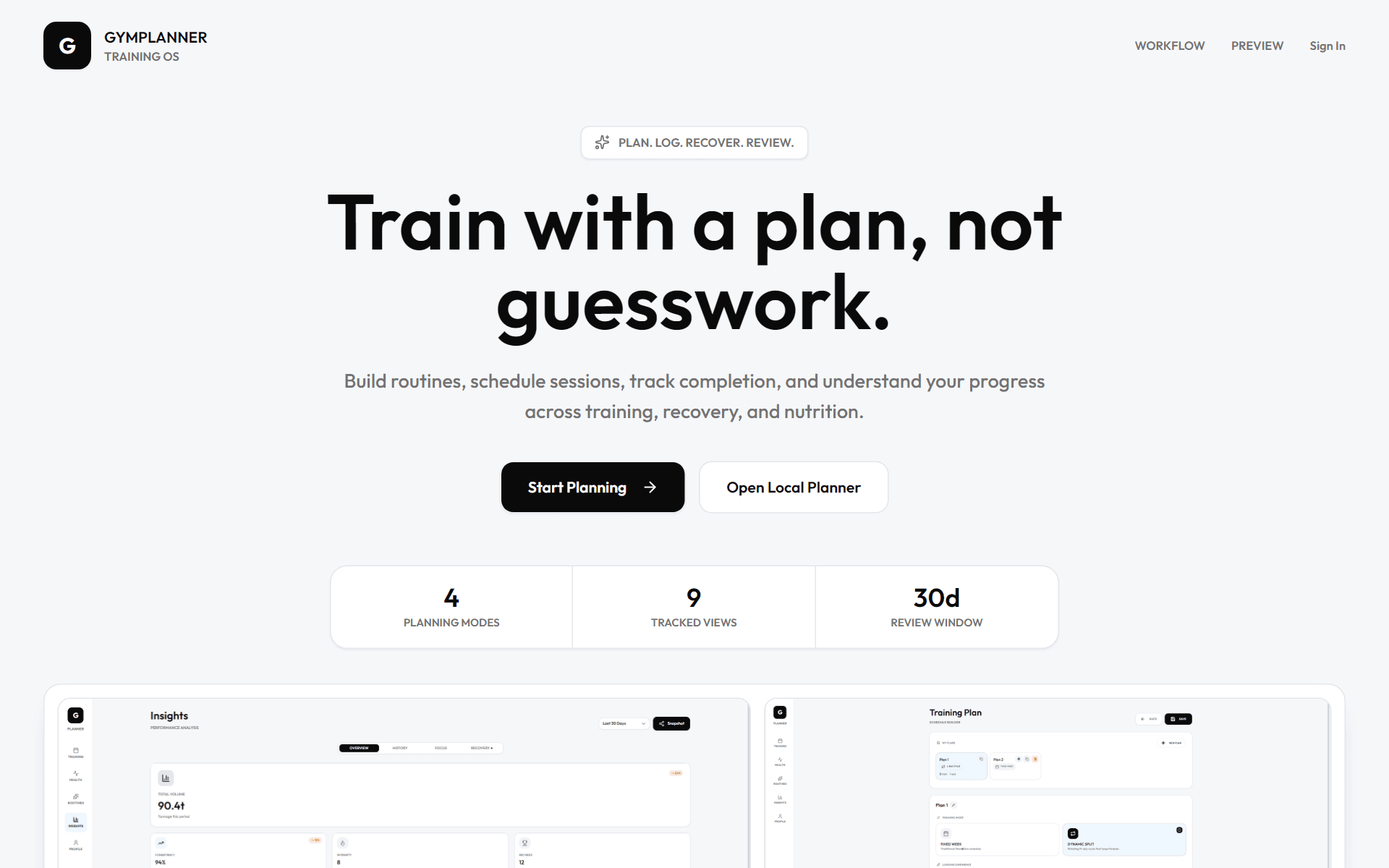
I designed the UI around a "Liquid Glass" language — translucency, depth, and a lot of restraint. Fitness apps tend toward either clinical spreadsheets or neon gamification, and I wanted something that felt like a premium tool you'd actually want to open at 6am.
Every screen had to survive one test: can I use it one-handed, sweaty, mid-set, in a hurry? That killed a lot of otherwise pretty ideas.
What I got wrong
I built the nutrition tracker before the workout logger was actually good. Classic mistake — chasing breadth because it feels like progress, while the core loop still had rough edges. The logger is the thing you touch forty times a session; the nutrition tab you touch three times a day. I had the priority exactly backwards for about a month.
Firebase rules came last. I got the sync working with permissive rules and told myself I'd tighten them later, which is how everyone ends up with an open database. I did fix it, but writing the rules first would have shaped the data model better and cost nothing.
What it taught me
This is the project that pushed me into backend work properly. Building the planner made me want a real exercise catalog, which became ExerciseDB API — and building that API is what taught me what "production-ready" actually means, as opposed to "it runs on my machine."